

In This Article
A compact drill driver for tight cabinet spaces is a cordless drill built short, light and narrow enough to work inside cabinet boxes, under sinks and behind toe-kicks. Its defining trait is a short head length, usually about 4.5 to 6.5 inches, paired with just enough torque for hinges and face-frame screws.

Here’s the thing nobody mentions in the glossy product photos: the screw is almost never the problem. Access is. A full-size drill can pack plenty of power and still be useless the moment you need to reach the back corner of a 12-inch-deep base cabinet. Your wrist bends, the bit wobbles, and the screw goes in crooked. Anyone who has tried knows the feeling.
That’s why this guide exists. Every model below is a real, currently documented product, compared on the dimensions that decide whether it fits: head length, chuck design, weight, torque and clutch control. Specs come from manufacturer and retailer listings, plus independent testing such as ProToolReviews’ Makita 12V CXT review, which ranks one of these drills inside a head-to-head 12V class.
Along the way you’ll see how a short head drill driver for cabinet installation differs from a generic 12V kit, why a low profile drill driver for inside cabinets can beat a stronger tool, and what a keyless chuck and true one-handed operation change in practice. No fluff. No spec dumping without meaning. Just the reasoning behind each pick.
Quick Comparison: 7 Compact Drill Drivers for Tight Cabinet Spaces
Lengths below are as reported by manufacturers, retailers or spec databases. Brands measure differently, so treat them as a guide and confirm with a tape measure.
| Model | Reported Length | Max Torque | Chuck | Best For |
|---|---|---|---|---|
| Milwaukee M12 FUEL 2505-22 | about 5.1 in | up to 300 in-lbs | Interchangeable heads, metal keyless chuck attachment | Inside corners and awkward angles |
| Bosch FlexiClick GSR12V-300FCB22 | about 4.5 in (114 mm, per a spec database) | 300 in-lbs | Keyless chuck attachment plus bit holder | Hinges and hardware in cramped boxes |
| Milwaukee M12 FUEL 3403-20 | about 5.95 in | 400 in-lbs | 1/2 in all-metal ratcheting | Maximum power in a small body |
| DeWalt DCD701 Xtreme 12V | about 6 in (152 mm) | 250 UWO (DeWalt rating) | 3/8 in ratcheting | Lightest all-day carry |
| Makita FD07 CXT | 6-1/16 in | 280 in-lbs | 3/8 in keyless | Balance and runtime |
| Ryobi ONE+ HP PSBDD01 | 6.4 in | up to 400 in-lbs | 1/2 in ratcheting | Budget buyers and ONE+ owners |
| Bosch GSR12V-300 | 6.0 in | 300 in-lbs | 3/8 in three-jaw keyless | Fine clutch control on finished faces |
Looking at the table, the Bosch FlexiClick GSR12V-300FCB22 and Milwaukee M12 FUEL 2505-22 win on pure access, because their modular heads change the shape of the tool rather than just trimming it. If you want one straight drill with real muscle, the Milwaukee M12 FUEL 3403-20 delivers 400 in-lbs without crossing the 6-inch line. The Ryobi ONE+ HP PSBDD01 is the longest here, which is the price of its 18V battery and low cost.
💬 Just one click — help others make better buying decisions too!😊
Top 7 Compact Drill Drivers for Tight Cabinet Spaces: Expert Analysis
Each entry below blends real specs with the themes that show up in published reviews. Where a representative pool of verified customer reviews couldn’t be confirmed, that’s stated plainly.
1. Milwaukee M12 FUEL Installation Drill/Driver (2505-22) — four heads, one compact body
This kit’s whole personality is shapeshifting: one motor body, four dedicated heads.
Milwaukee’s listing shows a right-angle head, an offset head, a 3/8 in metal chuck attachment and a 1/4 in hex attachment, with up to 300 in-lbs of torque. The tool runs about 5.1 inches and 2 lbs with a battery attached. In practice, that means the right-angle head can reach screws parallel to a cabinet wall, a spot where even a six-inch straight drill gives up. The hex-drive mode shortens it further, and the European sibling model lists a 130 mm length in that configuration.
Based on the spec comparison, this is the drill for installers who keep meeting corners that don’t allow a straight shot. The 300 in-lb ceiling is plenty for hinges, drawer slides and face-frame screws, though not for lag-style fastening. Published reviews found during research praise the flexibility; a representative Amazon star average couldn’t be verified, so weigh that evidence as thin.
Pros:
- ✅ Four heads cover straight, offset and right-angle work
- ✅ About 5.1 inches long and 2 lbs with battery
- ✅ Metal keyless chuck attachment for standard bits
Cons:
- ❌ Torque tops out below the 400 in-lb straight models
- ❌ More attachments to track and store
Expect premium-tier pricing, so check current price; it earns its keep if inside corners are routine.

2. Bosch FlexiClick GSR12V-300FCB22 — shortest straight-driving setup here
Bosch built the FlexiClick system around swapping tips in seconds, and that’s what makes it a cabinet specialist.
The brushless 12V body delivers 300 in-lbs and snaps between a keyless chuck attachment (locked in for drilling), a magnetic bit holder for driving, and angled options. One spec database lists the body at about 114 mm long (roughly 4.5 inches) and under 1.3 lbs. That’s short enough to drive a hinge screw with the bit almost touching the cabinet wall. The kit includes two 2.0 Ah batteries and a 3-year warranty on tool, battery and charger.
What the spec sheet won’t say plainly: the chuck attachment adds length, so the shortest setup is bit-holder driving rather than drilling. Roundup reviewers single this model out as a pick for cabinet installers, mostly for how close it puts the bit to walls and corners. Verified Amazon review volume couldn’t be confirmed during research.
Pros:
- ✅ Roughly 4.5-inch body in bit-holder mode
- ✅ 300 in-lbs from a brushless motor
- ✅ Two batteries included in the kit
Cons:
- ❌ Chuck attachment lengthens the tool for drilling
- ❌ Several loose attachments to manage
Pricing sits in the premium 12V range, so check current price; the versatility justifies it for cabinet-heavy work.
3. Milwaukee M12 FUEL 3403-20 — 400 in-lbs under six inches
Most 12V drills trade power for size. This one mostly refuses to.
Retail listings put the length at about 5.95 inches and the width at 2.25 inches, with 400 in-lbs, 1,500 rpm and an all-metal ratcheting 1/2 in chuck. That 1/2 in chuck matters when you need bigger spade or auger bits for a pipe or wire pass-through in a sink base. A retailer lists roughly 2.1 lbs, while another cites 2.5 lbs, so confirm the battery configuration you’re buying.
The analysis is simple: this is the “one drill” answer for people who build cabinets as well as hang them. It’s overkill for hinge screws alone, but it won’t bog down boring larger holes. Product pages and roundups call it the strongest compact in its class; individual verified reviews weren’t available to confirm that.
Pros:
- ✅ 400 in-lbs in a body under six inches
- ✅ All-metal ratcheting chuck holds bits firmly
- ✅ Shares the broad M12 battery ecosystem
Cons:
- ❌ Bare-tool pricing runs high for a 12V
- ❌ Longer than the installation-focused Milwaukee M12 FUEL 2505-22
Bare-tool listings run roughly $150-$230 depending on retailer, so check current price; strong value if you want power without 18V bulk.
4. DeWalt DCD701 Xtreme 12V — lightest carry on the list
At 1.9 lbs tool-only, this is the drill your forearm will thank you for at 4 p.m.
DeWalt describes it as 20% shorter than the previous generation, with 32% more power, two speeds, 15 clutch settings and a 3/8 in ratcheting chuck. European retailers list the length at 152 mm (about 6 inches). The LED foot light matters more than it sounds: inside a closed cabinet box, it lights the screw instead of casting your shadow over it.
On paper, 15 clutch steps are fewer than the 20+ on the Bosch models, so fine-tuning torque on thin veneer is a bit coarser. Retailer reviews include a self-described cabinetry carpenter who says it became a primary driver, and another who valued reduced hand fatigue; some of those reviews were collected as promotions, so weigh them accordingly.
Pros:
- ✅ Just 1.9 lbs without a battery
- ✅ Foot LED lights dark cabinet interiors
- ✅ 3/8 in ratcheting chuck grips bits well
Cons:
- ❌ Fewer clutch steps than the Bosch options
- ❌ Not the shortest or most powerful on this list
Bare tools list around $140-$180 and kits near the $170-$200 range, so check current price; good value for weight-sensitive work.
5. Makita FD07 CXT — slide battery, outstanding balance
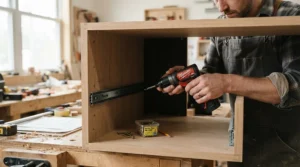
Makita’s slide-style battery lets this drill stand upright on its own, a small thing that pays off when you set it down inside a cabinet.
Makita lists 6-1/16 in length, 2.3 lbs with battery and 280 in-lbs of maximum torque. ProToolReviews found the tool tall but the shortest in length, praised its ergonomics, and measured the best screws-per-watt-hour in its class at 14.8, though it finished mid-pack overall. Efficiency matters for long installs: you’ll change batteries less often.
The catch is availability. Some retailers list the FD07Z bare tool as discontinued, and the newer FD09 trades some torque for more speed. Treat the FD07 as a “find it if you can” pick and verify stock before planning a kit around it.
Pros:
- ✅ Slide battery lets the tool stand upright
- ✅ Best efficiency in its tested class
- ✅ Comfortable, well-balanced grip
Cons:
- ❌ Taller profile hurts under shallow shelves
- ❌ Some retailers list it as discontinued
Pricing swings widely, roughly $110-$280 depending on bare tool versus kit; check current price and availability first.
6. Ryobi ONE+ HP PSBDD01 — the budget path for ONE+ owners
If your garage already runs on Ryobi batteries, this is the cheapest way into brushless compact territory.
Ryobi lists 6.4 inches, up to 400 in-lbs, 0-450/0-1,700 rpm, a 24-position clutch and a 1/2 in ratcheting chuck, plus 30% more compact and 20% lighter than its older brushed drill. ProToolReviews’ look at the HP compact line rates the power-to-weight ratio highly, and the newer PSBDD02 trims length to 6.25 inches with 2.1 lbs bare.
The honest tradeoff: the 18V battery adds weight, around 3.1 lbs with a 1.5 Ah pack on the newer model, and the head is the longest here. Reviewers consistently call the value strong; verified Amazon review counts couldn’t be confirmed.
Pros:
- ✅ Bare tool costs only around $100
- ✅ Runs on the huge ONE+ battery family
- ✅ 400 in-lbs with a 24-position clutch
Cons:
- ❌ Longest head length in this group
- ❌ 18V battery is heavier overhead
Kits for the newer model run about $130-$150, so check current price; excellent value if you already own batteries.
7. Bosch GSR12V-300 — the finesse driver for finished faces
Where others chase torque, this one chases control.
Bosch lists 300 in-lbs, 0-460/0-1,750 rpm, 20+1 clutch settings, a 3/8 in three-jaw keyless chuck, a 6.0 inch head length and 1.6 lbs tool-only. At about 2.1 inches wide, it slides into narrow gaps without catching. The clutch resolution is the real star: on a prefinished maple door, the difference between “snug” and “stripped” can be one click.
A carpenter’s review of an earlier Bosch 12V Max EC generation called that family a go-to for cabinet installation because of size and runtime, which fits this model’s design. The limit is that it’s a straight drill only, so angled corners need another tool.
Pros:
- ✅ 20+1 clutch settings protect delicate screws
- ✅ Just 1.6 lbs without a battery
- ✅ Slim 2.1-inch width fits narrow openings
Cons:
- ❌ No angle attachment system
- ❌ 3/8 in chuck limits larger bits
Bare tool roughly $130-$140 and a two-battery kit under $200, so check current price; strong value for finish work.
Price Range & Value Analysis
| Model | Typical Price Range | Battery Platform | Best For |
|---|---|---|---|
| Milwaukee M12 FUEL 2505-22 | Premium kit tier | M12 | Awkward corners |
| Bosch FlexiClick GSR12V-300FCB22 | Premium kit tier, roughly under $250 | Bosch 12V | Cabinet hardware |
| Milwaukee M12 FUEL 3403-20 | About $150-$230 bare | M12 | Power in a small body |
| DeWalt DCD701 Xtreme 12V | About $140-$200 | DeWalt 12V | Light all-day use |
| Makita FD07 CXT | About $110-$280 | Makita CXT | Balance, if in stock |
| Ryobi ONE+ HP PSBDD01 | About $100 bare | Ryobi ONE+ | Budget buyers |
| Bosch GSR12V-300 | About $130-$200 | Bosch 12V | Finish work |
The cheapest tool is only the cheapest if you already own its batteries, which is why the Ryobi ONE+ HP PSBDD01 shines for existing Ryobi households and loses its edge for everyone else. Buyers starting from zero get more value from a 12V platform like the Bosch GSR12V-300 or DeWalt DCD701, where the battery is smaller and lighter too. For ultra-low budgets, the Skil PWRCore 12 brushless kits land around $70-$100, though it’s physically larger than the true cabinet specialists, so check dimensions before buying.
✨ Don’t Miss These Exclusive Deals!
🔍 Take your cabinet projects to the next level with these carefully selected drills. Click on any highlighted item to check current pricing and availability. These tools will help you create clean, professional results your whole kitchen will love!
How to Choose a Compact Drill Driver for Tight Cabinet Spaces
Picking the right model is mostly a process of elimination. Work through these steps in order.
- Measure your tightest opening first. One roundup suggests staying under 6 inches for hinge-cup work in cabinetry, while another puts the stud-bay limit near 7 inches. Your worst-case gap sets the ceiling.
- Compare head length like for like. Some brands quote overall length, others head length, and attachments change both. A tape measure beats a spec sheet.
- Match torque to the job. A guide for cramped work suggests roughly 250-350 in-lbs for a drill driver, which covers hinges, slides and face frames.
- Check clutch resolution. Twenty settings protect veneer better than fifteen.
- Choose the chuck deliberately. A keyless chuck speeds bit changes; ratcheting and three-jaw styles differ in grip.
- Weigh the battery. A 12V pack keeps the tool nose-light and compact.
- Look for a work light. In a closed box, it’s not a luxury.
Head Length Explained: Why a Short Head Drill Driver for Cabinet Installation Wins
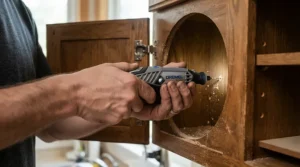
Head length is the distance from the chuck face to the back of the tool, and it controls two things at once: whether the bit reaches the screw, and how much of your wrist’s leverage you lose getting there.
Picture a 14-inch-deep base cabinet. With a 9-inch drill, the bit barely clears the front edge before the motor housing hits the face frame. With a 6-inch short head drill driver for cabinet installation, you’re drilling at the back corner with room to spare. That’s not a marginal gain; it’s the difference between working and improvising.
Shorter heads also pull the motor’s weight closer to your hand, which cuts the twisting force on your wrist when the bit stops. Combine that with a bit holder or short bit and the setup gets even tighter. The Bosch FlexiClick GSR12V-300FCB22 and Milwaukee M12 FUEL 2505-22 exploit this best, but the head length of any pick on this list beats a standard 18V drill. Remember, though: shorter doesn’t mean better if torque collapses, so balance both.
What to Expect: Real-World Performance of a Low Profile Drill Driver for Inside Cabinets
A low profile drill driver for inside cabinets behaves differently from the full-size drill you may be used to, and knowing how helps you avoid disappointment.
Expect fast, controlled work on hinge screws, drawer slides, shelf pins and cam-lock hardware. A 300 in-lb tool like the Bosch GSR12V-300 handles these without strain. Expect a slower pace on large holes: a 12V drill can bore 1-inch or larger holes but takes its time, and runtime drops accordingly. Heavy structural screws are better left to a bigger tool.
Battery size changes the experience too. A 2.0 Ah pack keeps the tool at its lightest, but a 4.0 Ah option improves runtime for day-long installs. Wide-body drills like the Makita FD07 CXT feel stable on a flat surface, while pencil-slim ones like the DeWalt DCD701 Xtreme 12V disappear into your hand. Neither is wrong; it’s a preference for how you work.
Keyless Chuck: What It Means Inside a Cabinet
A keyless chuck lets you tighten and loosen bits by hand, no key needed. In cabinet work, where you may swap between a pilot bit, a countersink and a driver bit a dozen times, that matters.
Three styles show up in this group. Ratcheting chucks (the Milwaukee M12 FUEL 3403-20, Ryobi ONE+ HP PSBDD01 and DeWalt DCD701 Xtreme 12V) click as they tighten and tend to hold firmly. Three-jaw keyless designs, like the Bosch GSR12V-300, grip hex and round shanks alike. Attachment-based systems, like the Bosch FlexiClick GSR12V-300FCB22, let you swap the whole business end.
The practical advice: tighten with the drill locked, check the bit by tugging, and keep the sleeve clean of dust. A keyless chuck on a short drill is also one less thing to lose in a dark cabinet, since no key means no hunting. For larger shanks, a 1/2 in chuck opens options a 3/8 in cannot.
One-Handed Operation: Grip, Balance and Trigger Reach
True one-handed operation is where a compact drill earns its keep. In a cabinet, your other hand is usually steadying a door, holding a hinge or bracing against the box.
Three features make it practical. First, weight: the DeWalt DCD701 Xtreme 12V at 1.9 lbs tool-only and the Bosch GSR12V-300 at 1.6 lbs sit well below full-size drills. Second, balance: the Makita FD07 CXT stands upright on its slide battery and feels centered in the palm. Third, trigger reach: shorter grips let your index finger find the trigger and a thumb find the direction switch without shifting.
The Milwaukee M12 FUEL 2505-22 adds an inline grip that points the force straight down the bit, which many installers find easier in awkward positions. Where one-handed operation falls apart is with 18V packs overhead, which is the quiet cost of the Ryobi ONE+ HP PSBDD01. Before buying, try holding a drill the way you’d actually use it.
Compact Drill Driver vs. Alternatives for Tight Spaces
A compact drill isn’t the only way into a cabinet. Right-angle drills and compact impact drivers also compete.
| Option | Typical Head Length | Strength | Weakness | Best For |
|---|---|---|---|---|
| Compact 12V drill driver (such as the Bosch GSR12V-300) | About 6 in | Versatile, clutch control | Can’t reach side-on angles | General cabinet work |
| Full-size 18V drill | Often 9 in or more | Raw power | Won’t fit most boxes | Framing, big holes |
| Right-angle drill (such as the Milwaukee 2415-20 or DeWalt DCD740B) | About 3.5-4 in | Unmatched reach | Awkward for general use | Inside corners |
| Compact impact driver (such as the Milwaukee 2953-20) | About 4.5-5.5 in | Strong driving torque | Rattly, no fine clutch | Long screws, not hinges |
The table makes the tradeoff obvious: a right-angle drill wins pure access but loses versatility, while an impact driver wins torque but loses finesse on finished faces. For most people, one compact drill driver plus an optional angle head covers nearly everything. If your cabinet work is occasional, start with the drill; add a specialist tool only after you hit a corner it can’t reach.

Long-Term Cost & Maintenance
The sticker price is only the opening bid. Total cost depends on batteries, warranties and how long the tool lasts.
A bare tool looks cheap until you need batteries and a charger, which can double the cost. That’s why a platform you already own matters so much. Warranty length also varies: Bosch lists three years on tool, battery and charger, while retail listings cite five years for the Milwaukee M12 FUEL 3403-20. Brushless motors, standard on every pick here, generally run cooler and last longer than brushed designs.
Maintenance is simple but worth doing. Blow dust from the chuck sleeve, keep contacts clean, and store batteries partly charged in a cool place. Check the CPSC recall database before buying batteries from unfamiliar sellers, and avoid off-brand packs. Over five years, a mid-priced 12V kit often costs less per project than a cheap tool replaced twice.
Practical Usage Guide: Setting Up Your Drill for a Cabinet Install
A few minutes of setup prevents most first-day mistakes. Follow this routine before you touch the first screw.
- Charge and label batteries. Keep one on the drill, one on the charger.
- Set the clutch low. Start near the bottom, test on scrap, and move up one step at a time.
- Pick the right bit. Use a pilot bit for hardwood and a short driver bit for tight spots.
- Seat the chuck firmly. Tighten by hand, then give the bit a tug.
- Use low speed for starting. Switch to the faster gear only for drilling.
- Clear the workspace. Remove shelves and drawers so you aren’t fighting the box.
Common mistakes in the first 30 days: over-tightening hinge screws, leaving the clutch on drill mode, and skipping eye protection. On that last point, OSHA’s hand and power tools guidance is a good reminder that safety glasses and a firm stance apply to home projects too. Add a magnetic bit holder, and you’ll thank yourself every time a screw nearly drops into the cabinet.
Real-World Scenarios: Which Drill Matches Which Buyer?
Matching tool to person is where most buying guides go wrong. Here are three profiles.
The weekend kitchen remodeler. Hanging 14 upper cabinets over two weekends, this buyer needs reach, light weight and a fair price. The Bosch GSR12V-300 or DeWalt DCD701 Xtreme 12V fits: low weight cuts shoulder fatigue overhead, and the clutch protects new finishes. Budget around a kit price under $200.
The professional installer. Daily installs mean battery runtime and speed matter most. The Milwaukee M12 FUEL 3403-20 brings the power, while the Milwaukee M12 FUEL 2505-22 handles inside corners. Together they cover nearly every install.
The Ryobi household. Someone with a shelf of ONE+ batteries and a modest budget gets the best deal from the Ryobi ONE+ HP PSBDD01, accepting a slightly longer head in exchange for near-zero battery cost. For the hardest-to-reach screws, they can add a separate right-angle tool later.
Problem → Solution Guide: Common Cabinet Drilling Headaches
Even good drills run into predictable trouble. Here’s how to fix it.
Problem: the drill won’t fit behind the face frame. Switch to a bit-holder setup on the Bosch FlexiClick GSR12V-300FCB22 or use the right-angle head on the Milwaukee M12 FUEL 2505-22.
Problem: screws strip or crack the veneer. Lower the clutch and pre-drill pilot holes. A 20-step clutch like the Bosch GSR12V-300 gives the finest control.
Problem: the bit slips in the chuck. Retighten by hand, then clean the jaws. A ratcheting chuck like the Ryobi ONE+ HP PSBDD01 can help with stubborn shanks.
Problem: the battery fades mid-install. Carry a second pack, or choose a platform known for efficiency such as the Makita FD07 CXT.
Problem: it’s too dark to see the screw. Pick a model with a built-in light, like the DeWalt DCD701 Xtreme 12V.

FAQ
❓ What head length is short enough for most base cabinets?
❓ Is a 12V drill driver strong enough for cabinet hardware?
❓ Do I need a keyless chuck for cabinet work?
❓ Can I really use a compact drill with one hand inside a cabinet?
❓ Should I buy an angle attachment or a separate right-angle drill?
Conclusion
Tight cabinets reward tools that respect geometry. The best compact drill driver for tight cabinet spaces isn’t automatically the most powerful; it’s the one that reaches the screw, holds the bit firmly and lets you drive with one hand while the other steadies the work.
For most people, the Bosch GSR12V-300 or DeWalt DCD701 Xtreme 12V hits the sweet spot of weight, size and control. Installers who face awkward corners daily will get more from the Milwaukee M12 FUEL 2505-22 or Bosch FlexiClick GSR12V-300FCB22, and anyone chasing power in a small body should look at the Milwaukee M12 FUEL 3403-20. Budget buyers already on Ryobi batteries can lean on the Ryobi ONE+ HP PSBDD01, while the Makita FD07 CXT remains a smart find if stock allows.
Whichever you pick, check head length against your real openings, confirm current pricing and availability, and match the clutch to your finish. A few minutes of homework now saves hours of improvising later.
✨ Ready to find your fit? 🔧 Check current pricing on your favorite pick today and give your cabinets the clean, crooked-screw-free finish they deserve! 🚪
Recommended for You
- Cordless Drill Driver for Seniors with Arthritis: 7 Best Picks (2026)
- Drill Driver Bit Set Accessories for Drywall Screws: 7 Best Picks 2026
- Drill Driver for Assembling Flat Pack Furniture: 7 Proven Picks 2026
Disclaimer: This article contains affiliate links. As an Amazon Associate, I earn from qualifying purchases. If you purchase products through these links, we may earn a small commission at no additional cost to you.
✨ Found this helpful? Share it with your friends! 💬🤗
